
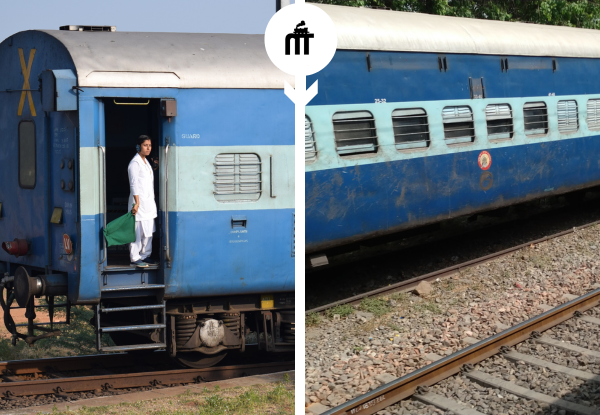
If you’ve ever stared at a long Indian train and wondered why almost every coach is blue, the answer is surprisingly simple. It is not about style. It is about what works best on the ground.
Most Indian trains are blue because of the large number of ICF coaches built and used across the network. These coaches were standardized in blue for sleeper and general classes, and once thousands of them entered service, the color became the default look of Indian Railways.
Now here is the practical side. Blue is actually a very sensible choice. It hides dust, stains, and everyday wear much better than lighter colors, which matters a lot in a country where trains run through dust, pollution, and all kinds of weather. At the same time, it does not absorb as much heat as darker colors like black, making it a reasonable middle ground for India’s hot climate.
So over time, what started as a practical decision quietly turned into an identity. Today, blue trains are not just common, they are almost symbolic. You see one in the distance, and you instantly know it is an Indian train, even before reading anything on it.
In short, Indian trains are blue because the color is durable, practical, and standardized at scale. And somewhere along the way, practicality became tradition.
The Real Origin: The ICF Standard
The biggest reason behind blue trains is not science. It is standardization.
Most trains you see today still use ICF coaches, manufactured by the Integral Coach Factory in Chennai. From the 1970s onward, these coaches were produced in massive numbers and painted in a blue livery for sleeper and general classes.
Once thousands of coaches were built with the same color, it became the default across the network.
Changing that later is not simple. You are not repainting one train. You are dealing with tens of thousands of coaches.
So the blue stayed.
Why Blue Actually Makes Sense
Now comes the interesting part. Even though blue started as a standard, it also turned out to be a very practical choice.
1. It Handles Dirt Like a Pro
Indian trains run through:
- Dust-heavy regions
- Industrial areas
- Open tracks
- Monsoon mud
If trains were white, they would look dirty within hours.
Blue helps because:
- Dust is less visible
- Grease marks blend in better
- Scratches are not very obvious
In simple terms, blue makes trains look “clean enough” for longer without constant washing.
2. It Is a Smart Heat Compromise
Color affects heat. This is basic physics.
- Dark colors absorb more heat
- Light colors reflect heat but get dirty fast
Blue sits in the middle.
It does not absorb as much heat as black, and it does not show dirt like white. For a country where temperatures can cross 45°C, this balance matters, especially for non AC coaches.
3. Maintenance Becomes Easier and Cheaper
Indian Railways operates one of the largest rail networks in the world. That means:
- Frequent repainting is expensive
- Cleaning time is limited
- Coaches are constantly in use
A color like blue reduces:
- Visible wear and tear
- Cleaning frequency pressure
- Repainting urgency
Multiply that across thousands of coaches, and it becomes a huge operational advantage.
👀 Did You Ever Notice This?
Next time a train passes by, look closely. Sleeper coaches are almost always blue, but premium trains suddenly switch colors. That’s not random. It’s the story of old vs new Indian Railways happening right in front of you.
When Blue Became an Identity
Here is where things get interesting.
What started as a practical decision slowly became something else.
Over decades, people got used to seeing long blue trains everywhere. It became familiar. Recognizable. Almost iconic.
Today, if someone says “train” in India, most people picture a blue sleeper coach without even thinking.
That is not branding. That is repetition turning into identity.
But Not All Trains Are Blue
Now to clear a common misconception.
Not every Indian train is blue.
In fact, newer trains are moving away from it.
- LHB coaches often use red or grey
- Rajdhani Express uses red and cream
- Vande Bharat uses white with blue accents
So why do we still see so much blue?
Because a large part of the fleet is still made up of ICF coaches, and replacing them takes time, money, and planning.
The Transition Is Already Happening
if you start paying a little attention while traveling, you will notice something interesting. Not all trains look the same anymore.
That is because Indian Railways is slowly moving from old ICF coaches to newer LHB coaches. This change did not happen overnight, and honestly, it cannot.
LHB coaches are better in several real, practical ways:
- They are safer, especially during accidents. Unlike older coaches, they are designed to reduce piling up during collisions
- They are built for higher speeds, which helps improve overall efficiency
- They offer a smoother and quieter ride, something frequent travelers notice immediately
Now here is the important part. Even though LHB coaches are becoming more common, Indian Railways is too big to change everything at once.
We are talking about thousands and thousands of coaches spread across the country. Replacing all of them means:
- Manufacturing new coaches
- Phasing out old ones
- Adjusting maintenance systems
- Managing costs at a national scale
So what Indian Railways is doing instead is gradual replacement. Old coaches are being retired step by step, and new ones are being added in phases.
That is why you might see something like this:
One train is fully blue
Another train is red
And sometimes, even a mix during transitions
It is not random. It is the system slowly upgrading itself.
So yes, blue trains are slowly reducing. But they are not disappearing anytime soon.
Think of it like an old city being modernized. New buildings come up, but the old ones do not vanish overnight. They stay, they function, and they slowly make way for the future.
That is exactly what is happening with Indian trains right now.
🔗 Sources & References
Verified sources used to ensure accurate and reliable information: